Highlights from the Natural Science Baltic Conference
This page is dedicated to summaries of the most outstanding research presented at the Natural Science Baltic Conference (NSBC). It features selected oral presentations and scientific posters, highlighting their key findings, innovative approaches, and most significant conclusions.
Kacper Tomasik
Beyond kin killing: can tailocins reshape plant-associated microbiomes?
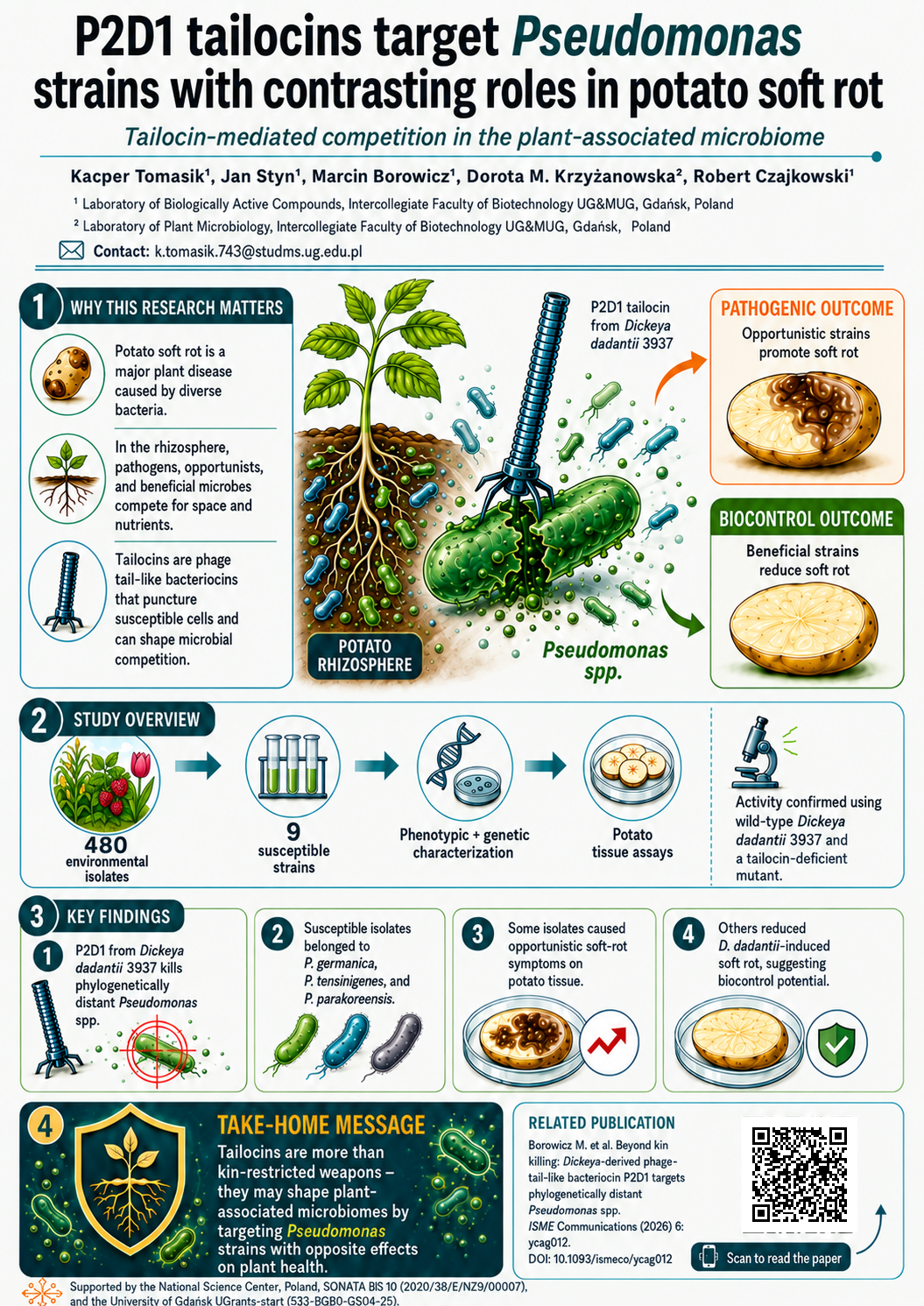
Can we use tailocins to shape plant-associated microbial communities? To do so, we need agents with a well-understood range of activity and predictable effects on the bacteria living in association with plants. Our work on P2D1 brings us one step closer to this possibility. The rhizosphere is a competitive environment where root-associated bacteria compete for nutrients and space. Among their molecular weapons are tailocins – contractile, phage tail-like bacteriocins that recognize susceptible cells and disrupt their envelopes. Although often considered narrow-range weapons acting mainly against close relatives, their role in microbial communities remains poorly understood. We investigated P2D1, a tailocin produced by Dickeya dadantii 3937, a potato soft-rot pathogen. We asked whether its susceptibility range extends beyond closely related Soft Rot Pectobacteriaceae and whether selective killing could influence plant-associated microbial communities. This is especially relevant in potato microbiomes, where pathogens, opportunists, competitors, and protective bacteria coexist. Soft rot illustrates why disease can be viewed as a community process rather than only a plant-pathogen interaction. To define the target range of P2D1, we screened 480 environmental isolates from soil and rhizosphere habitats in Poland. Only nine were susceptible and, unexpectedly, none belonged to Soft Rot Pectobacteriaceae. All were Pseudomonas spp., related to P. germanica, P. tensinigenes, and P. parakoreensis. A P2D1-deficient D. dadantii mutant lost antagonistic activity, confirming killing across taxonomic boundaries. Importantly, susceptible strains had contrasting ecological roles. Three P. tensinigenes-related isolates could macerate potato tissue, whereas six nonpathogenic isolates reduced D. dadantii-induced soft rot, indicating disease-suppressive potential. Thus, P2D1 can target bacteria with opposing effects on plant health. These findings reframe how tailocins may influence microbial communities. Due to their potency and specificity, tailocins could potentially allow targeted removal of selected bacteria without broadly disturbing the community. At the same time, this precision creates complexity: depending on the ecological role of the susceptible strain, its removal could help reduce disease by eliminating a disease-promoting bacteria, but it could also unintentionally weaken natural disease suppression by targeting a potentially protective member of the microbiome. Therefore, tailocins may be valuable not only as antibacterial agents but also for understanding microbial community assembly. Defining who is targeted and how communities respond to selective removal will be essential before considering microbiome engineering. Our study positions P2D1 as more than a bacterial weapon: a potential ecological selector across taxonomic boundaries. The key question is no longer simply: which bacteria can a tailocin kill? Rather: how does selective killing reshape the microbiome and ultimately plant health?
Authors: Kacper Tomasik, Jan Styn, Marcin Borowicz, Dorota M. Krzyżanowska, Robert Czajkowski Funding: National Science Center, Poland, SONATA BIS 10 (2020/38/E/NZ9/00007), R. Czajkowski; University of Gdansk, UGrants-start (533-BGB0-GS04-25),
M. Borowicz. Full publication: Borowicz M. et al. Beyond kin killing: Dickeya-derived phage-tail-like bacteriocin P2D1 targets phylogenetically distant Pseudomonas spp. ISME Communications. 2026;6:ycag012. doi:10.1093/ismeco/ycag012
(grafika poniżej wygenerowana przez AI)
PhD Karolina Beton-Mysur
Dr. Karolina Beton-Mysur is an Assistant Professor at the Institute of Applied Radiation Chemistry at the Faculty of Chemistry at the Lodz University of Technology (Poland), specializing in vibrational spectroscopy, chemical and biochemical imaging, nanomechanics, and biomedical applications of advanced analytical techniques. Her research focuses on understanding cellular metabolism and disease-related biochemical changes through innovative label-free imaging approaches that provide molecular-level information without the need for dyes or markers.
Her work combines Raman spectroscopy and imaging, atomic force microscopy (AFM), fluorescence microscopy, chemometric analysis, and nanospectroscopy to investigate normal and cancerous human cells and tissues. A major goal of her research is to identify metabolic biomarkers associated with disease development, particularly gastrointestinal tract cancers, and to develop innovative diagnostic strategies that support earlier detection and personalized medicine.
In recent years, Dr. Beton-Mysur has pioneered studies exploring how biologically active compounds, including antidepressants, statins, fatty acids, vitamins, amino acids, and other environmental or dietary factors, influence cellular metabolism. Her research has revealed distinct metabolic responses in normal and cancerous colon cells, including characteristic signatures associated with different stages of tumor aggressiveness, demonstrating the power of Raman spectroscopy and imaging to monitor biochemical reprogramming at the single-cell and subcellular levels. These findings contribute to a deeper understanding of cancer biology, drug action beyond primary therapeutic targets, and the molecular mechanisms underlying disease progression.
Dr. Beton-Mysur has authored numerous peer-reviewed publications in leading international journals, including Analytical Chemistry, Journal of Physical Chemistry B, Scientific Reports, Spectrochimica Acta Part A, Molecules, International Journal of Molecular Sciences, Analyst, and Biochimica et Biophysica Acta (BBA) – Molecular Basis of Disease. Her recent work on tracking metabolic responses to citalopram in colon cells and on Raman-based monitoring of lipid metabolic reprogramming has received international recognition.
Beyond her scientific achievements, she is actively involved in international collaborations and research mobility initiatives. She has conducted research stays at the University of Twente (The Netherlands), Ludwig Maximilian University of Munich (Germany), and the University of Aveiro (Portugal). She also leads several research projects and serves as an expert reviewer for the Polish Medical Research Agency.
Her scientific excellence has been recognized through numerous prestigious awards, including the Pharmaceuticals Young Investigator Award, the Biomedicines Young Investigator Award, the Polish Academy of Sciences Award for the best doctoral dissertation in analytical chemistry, and multiple awards for outstanding scientific presentations.
Through interdisciplinary research spanning chemistry, biology, nanotechnology, and medicine, Dr. Beton-Mysur aims to advance non-invasive molecular diagnostics and improve our understanding of the biochemical mechanisms underlying human health and disease. Her work bridges fundamental science and clinical relevance, contributing to the development of next-generation diagnostic and therapeutic approaches.
Research Profiles and Selected Links: ORCID: https://orcid.org/0000-0001-5278-3447 ResearchGate: https://www.researchgate.net/profile/Karolina-Beton-Mysur?ev=hdr_xprf Scopus Author Profile: https://www.scopus.com/authid/detail.uri?authorId=58043965700 Facebook: https://www.facebook.com/karolina.beton Instagram: https://www.instagram.com/karolinabeton/
PhD. Eng. Patrycja Jutrzenka-Trzebiatowska
Towards a Cleaner South Baltic: The Circular Ocean‑Bound Plastic (COP) Project
Every year, 1.6–2.4 million tonnes of plastic are carried by rivers into the world’s oceans, while 80% of marine litter originates on land. Preventing plastic from reaching the sea is one of the most effective ways to reduce marine pollution. The Circular Ocean‑Bound Plastic (COP) project, funded by Interreg South Baltic 2021–2027, addresses this challenge by testing methods for collecting riverine plastic, litter monitoring, and proposing recycling pathways that return this material to circular value chains. To address these challenges, the COP project tested three complementary approaches in different South Baltic cities:
- Aarhus (Denmark) – SeaProtectorOne, an automated collection system equipped with sensors and a robotic arm that continuously removes floating litter from the river.
- Rostock (Germany) – PortBins, units installed at pollution hotspots to collect floating waste from the water surface.
- Gdańsk (Poland) – EcoKayak, a citizen‑driven initiative, where participants collect litter while kayaking, combining cleanup with environmental education.
These approaches demonstrate that effective interception requires a mix of technology, spatial analysis, and community engagement.
The litter profiles varied between locations: 30% of all collected litter from Aarhus River was single‑use plastic cups, in Rostock cigarette butts made up 25%, while in Gdańsk bottles and can made up almost 50% of all collected litter. The project also evaluated the recycling potential of river-collected plastics. Studies revealed that the most common polymers found in collected waste were polypropylene (PP), polyethylene (PE) and PET. Although contamination and weathering remain challenges, proper sorting, cleaning and processing significantly improve recycling potential. Mechanical recycling tests showed that recovered PP retained properties close to virgin material, while chemical recycling achieved complete depolymerisation of PET and polycarbonate, recovering 70–75% of PET monomers. Together, these findings demonstrate that ocean-bound plastic can become a valuable resource when supported by appropriate collection, sorting and recycling technologies.
Acknowledgments: This work was funded by the Interreg South Baltic Programme 2021-2027 within the scope of the project “Circular Ocean-bound Plastic” No.STHB.02.03-IP.01-0006/23-00. Project co-financed by the Polish Ministry of Science and Higher Education under the programme entitled Co-financed International Projects, No. 6101/INTERREG VI-A/2024/2025/2 Link: https://circularoceanplastic.eu/